
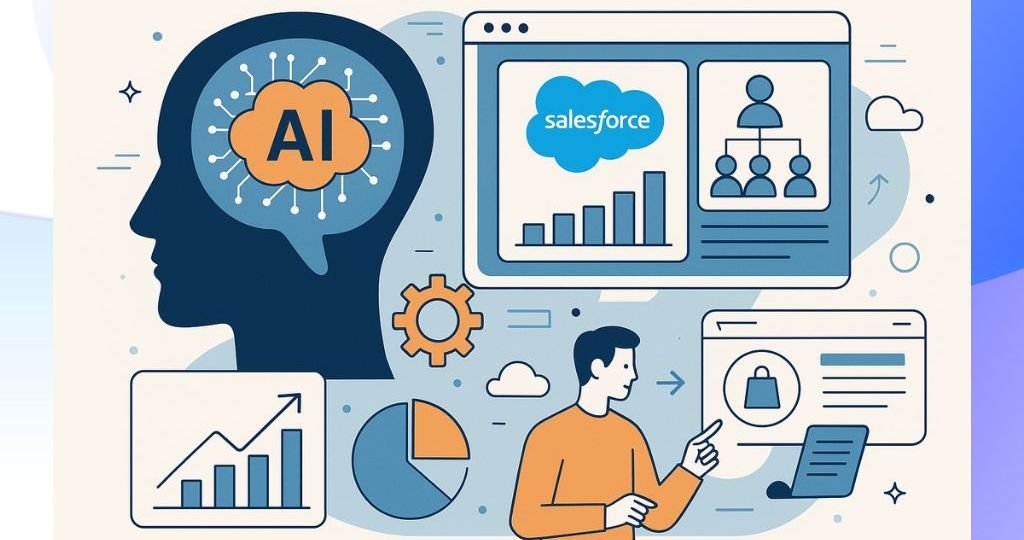
The landscape of customer relationship management is undergoing a profound transformation. As AI technology matures and integrates deeper into platforms like Salesforce, we’re witnessing a fundamental shift in how businesses understand, engage, and serve their customers. This isn’t just incremental improvement—it’s a complete reimagining of what’s possible with CRM technology.
From Data Repository to Intelligent Partner
Traditional CRM systems have long served as sophisticated databases, storing customer information and tracking interactions. But AI is elevating Salesforce from a passive repository to an active, intelligent partner in your business operations. The platform now anticipates needs, surfaces insights, and takes action—transforming the very nature of customer relationship management.
According to Salesforce’s own data, Einstein now delivers more than 80 billion AI-powered predictions every day across all Salesforce products, demonstrating the massive scale at which AI is now operating within enterprise CRM systems1.
Smarter Customer Insights: From Reactive to Predictive
The Challenge of Data Overload
Modern businesses are drowning in data. Every customer interaction, transaction, and touchpoint generates information that gets stored in Salesforce. The problem? Having data and extracting meaningful insights from it are two entirely different challenges. Teams spend countless hours building dashboards, running reports, and trying to identify patterns manually.
How AI Changes the Game
AI-powered analytics in Salesforce flips this paradigm entirely. Instead of you searching for insights, the insights find you. Machine learning algorithms continuously analyze customer data to predict behavior, identify emerging trends, and surface opportunities that would otherwise remain hidden in the noise.
Einstein Analytics, for example, can detect that a high-value customer’s engagement has dropped by 40% over the past month—even before your account manager notices. It identifies which products are trending with specific customer segments before traditional analysis would reveal the pattern. It recognizes early warning signs of churn by analyzing dozens of behavioral signals simultaneously.
Practical Impact
Research shows that businesses that use a CRM with generative AI are 83% more likely to exceed their sales goals compared to those that don’t leverage AI capabilities2. The key difference is proactivity. You’re no longer looking backward at what happened; you’re looking forward at what’s likely to happen and taking action before opportunities are missed or problems escalate.
Real-world implementations demonstrate tangible results. Orvis’ most engaged customer segment grew by 20 percent after using Einstein for personalized communications, with traffic increasing more than 30 percent and click-through rates by 22 percent3. The company also responds to customer trends 6x faster through AI insights from marketing efforts.
Automated Workflows That Actually Work
Beyond Basic Automation
Salesforce has offered automation capabilities for years through tools like Process Builder and Flow. But traditional automation is rigid—it follows predefined rules without context or judgment. AI-powered automation is fundamentally different because it learns, adapts, and makes intelligent decisions.
Intelligent Lead Prioritization
Consider lead management. Traditional systems might prioritize leads based on simple criteria: company size, job title, or engagement score. AI goes several layers deeper. It analyzes hundreds of data points—how similar leads behaved in the past, what content they’ve consumed, their digital body language, timing patterns, and even external signals like company news or industry trends.
The impact is measurable. Studies show that companies using AI-powered lead scoring have seen a 30-40% increase in lead conversion rates due to enhanced accuracy and real-time updates4. One sales organization implementing Einstein Lead Scoring doesn’t just rank leads; the system explains why each lead received its score and predicts the likelihood of conversion with remarkable accuracy—a level of precision impossible with manual scoring.
Furthermore, real-time AI coaching and conversational analysis in CRM systems improve qualified lead conversion rates from 45.5% to 64.1%5, demonstrating the compounding benefits when multiple AI capabilities work together.
Contextual Email Generation
AI can now draft personalized emails that don’t feel robotic. By analyzing successful email patterns, understanding the recipient’s history with your company, and considering the current context, tools like Einstein GPT generate compelling, relevant messages that your sales team can review and send in seconds rather than minutes.
A financial services firm implemented AI-assisted email drafting and saw their sales team’s daily email output increase by 300% while maintaining—and even improving—response rates. The AI learned their brand voice, understood compliance requirements, and adapted messaging based on what historically worked with different customer segments.
Intelligent Record Updates
Perhaps most impressive is AI’s ability to update records based on conversation context. When a sales rep has a phone call with a prospect, AI can listen (with appropriate consent and privacy protections), understand the key points discussed, and automatically update opportunity fields, log next steps, and even create tasks for follow-up actions mentioned in the conversation.
According to industry data, AI-enhanced CRM solutions can automatically update and maintain up to 92% of sales records, reducing errors and enhancing data accuracy5. This eliminates the administrative burden that sales professionals despise, allowing them to move directly to their next interaction.
Real-Time Personalization at Scale
The Personalization Imperative
Today’s customers expect personalization. They’re accustomed to Netflix recommending shows they’ll love, Amazon suggesting products they need, and Spotify curating playlists that match their mood. When they interact with your business, they expect the same level of understanding and relevance.
The challenge is delivering personalization at scale across thousands or millions of customer interactions. This is where AI integrated into Salesforce becomes transformative.
Dynamic Product Recommendations
AI analyzes purchase history, browsing behavior, support interactions, and similar customer patterns to recommend products or services that each customer is most likely to need next. These recommendations appear in real-time across all touchpoints—whether a customer is talking to a service agent, browsing your website, or engaging with a marketing email.
An e-commerce retailer using Einstein Recommendations saw their average order value increase by 35% and cross-sell conversion rates double within six months. The AI identified product affinities that their merchandising team had never considered, creating unexpected but highly effective pairing suggestions.
Adaptive Support Responses
When a customer contacts support, AI instantly analyzes their entire history with your company, identifies similar cases that were resolved successfully, and suggests solutions to the agent in real-time. But it goes further—it adapts the communication style based on the customer’s preferences and emotional state detected through sentiment analysis.
Research indicates that 86% of CRM leaders leveraging AI opined that it has improved their customer satisfaction scores6, while 83% of CRM leaders report that AI makes their job easier to handle service requests, saving them time6.
Moment-Based Engagement
AI enables true moment-based marketing by identifying the optimal time, channel, and message for each individual customer. Instead of batch-and-blast campaigns, your marketing becomes a series of perfectly timed, individually relevant conversations.
According to Salesforce metrics, Einstein for Marketing Cloud daily predictions increased by 67% in Q3 to help marketers create more personalized messages1. A financial institution using this approach reported email open rates increasing from 18% to 47% simply by optimizing send times individually rather than using a one-size-fits-all schedule.
The Strategic Advantages: Beyond Operational Efficiency
Elevated Customer Experience
The most significant impact of AI in Salesforce isn’t just operational—it’s experiential. Customers feel genuinely understood when your company anticipates their needs, responds with relevant solutions, and personalizes every interaction. This emotional connection drives loyalty far more effectively than discounts or promotions ever could.
Industry research confirms that 53% of businesses experience improved customer satisfaction and retention with CRM tools2. Furthermore, implementing CRM tools helped respondents increase customer satisfaction by 47%7, with customers who rate their experience as excellent having a lifetime value 14 times higher than those who rate it merely okay.
Empowered Teams
AI doesn’t replace human judgment; it amplifies it. By automating routine tasks and surfacing relevant insights, AI allows your teams to focus on what humans do best—building relationships, solving complex problems, and applying creative thinking to unique situations.
Sales professionals become trusted advisors rather than data entry clerks. Support agents become problem-solving experts rather than script-readers. Marketers become strategic orchestrators rather than campaign executors. The result is more engaged employees who find greater meaning and satisfaction in their work.
Competitive Differentiation
Organizations that effectively integrate AI with Salesforce create competitive advantages that are difficult to replicate. The AI models become smarter over time, learning from your specific customer base, industry dynamics, and business processes. This creates a virtuous cycle where better insights lead to better decisions, which generate better data, which produces even better insights.
Your competitors can buy the same technology, but they can’t replicate the institutional knowledge embedded in your AI models or the organizational capabilities you’ve built around these tools.
Real-World Results: The Numbers Don't Lie
Conversion Rate Improvements
The data on conversion improvements is compelling. According to Forrester, companies that use AI-powered lead scoring experience a 25% increase in conversion rates and a 15% reduction in customer acquisition costs8. Additionally, Salesforce reports that its AI-powered lead scoring feature has helped businesses achieve a 30% increase in sales productivity and a 20% increase in sales revenue8.
Even more impressive, the American Marketing Association reports that companies using AI-powered lead scoring models experience a 79% increase in lead conversion rates and a 54% reduction in sales cycle length8.
Customer Satisfaction Gains
Service organizations using Einstein Bots and AI-powered case routing report significant improvements. Data shows that Einstein Bot sessions increased by 300% since February, representing a 680% increase compared to 20191. A telecommunications provider reduced average resolution time from 48 hours to 6 hours by using AI to instantly route cases to the right specialist with all relevant context pre-loaded.
The Sun Basket case demonstrates the potential: their Einstein Bots now have the same or even better Customer Effort Score than human agents at 90+ percent1, showing that AI can match or exceed human performance in specific contexts while scaling infinitely.
Revenue Growth
Perhaps most importantly, businesses are seeing top-line growth. Research indicates that 57% of businesses report increased sales revenue as a key benefit of CRM software9, while businesses that use a CRM are 86% more likely to exceed their sales goals than those that don’t9.
The combination of better conversion rates, higher customer satisfaction, increased retention, and more effective upselling creates compounding revenue benefits. One manufacturing company attributed 18% of their annual revenue growth directly to AI-driven initiatives in Salesforce, including predictive maintenance alerts that reduced churn, personalized product recommendations that increased wallet share, and intelligent pricing suggestions that improved margins.
Overcoming Implementation Challenges
Data Quality: The Foundation
AI is only as good as the data it learns from. Before implementing AI capabilities, organizations must invest in data hygiene. This means deduplicating records, standardizing data formats, filling information gaps, and establishing governance processes to maintain quality going forward.
Industry statistics reveal the scope of this challenge: a concerning 37% of CRM users reported losing revenue as a direct consequence of poor data quality10, while 76% of CRM users said less than half of their organization’s CRM data is accurate and complete10.
Many companies discover that their biggest obstacle isn’t the AI technology itself—it’s the state of their data. But this challenge also presents an opportunity. The process of preparing data for AI often reveals inefficiencies and inconsistencies that were hurting performance even before AI entered the picture.
Change Management: The Human Factor
Technology adoption ultimately depends on people. Teams need training not just on how to use AI-powered tools, but on how to interpret AI recommendations, when to trust the system, and when to apply human judgment.
Research shows that three out of five workers (61%) currently use or plan to use generative AI11, but concerns remain. Half of workers (54%) worry generative AI outputs are inaccurate, and 59% worry the outputs are biased11. These concerns highlight the importance of proper training and transparent communication about AI capabilities and limitations.
Successful implementations typically include champions who demonstrate value to their peers, clear communication about how AI augments rather than replaces human roles, and gradual rollouts that allow teams to build confidence with simpler use cases before tackling complex scenarios.
Ethical Considerations: Building Trust
As AI makes more decisions that affect customers, ethical considerations become paramount. How transparent should you be about AI’s role in interactions? How do you ensure AI doesn’t perpetuate biases present in historical data? What safeguards prevent AI from making recommendations that prioritize short-term revenue over long-term customer relationships?
Organizations that address these questions proactively, establishing clear principles and governance frameworks, build stronger customer trust and avoid potential reputation risks. Salesforce provides tools like Einstein Trust Layer to help manage these concerns, but organizational commitment to ethical AI use must come from leadership.
The Evolution Continues: What's Next
Autonomous Agents
The next frontier is truly autonomous AI agents that can handle complex, multi-step processes with minimal human supervision. Salesforce has already begun introducing agent-based AI capabilities through Agentforce, and their evolution will accelerate dramatically over the coming years.
According to recent reports, more than 5,000 businesses — including Indeed, OpenTable, and Heathrow Airport — are using Agentforce to automate customer interactions and streamline processes12. Imagine an AI agent that identifies a cross-sell opportunity, researches the customer’s needs, drafts a proposal, schedules a meeting, prepares presentation materials, and follows up after the conversation—all while keeping human team members informed and seeking approval only for major decisions.
Multimodal Understanding
Future AI will seamlessly analyze text, voice, images, and video to gain comprehensive understanding of customer needs and sentiment. A support agent might receive real-time insights based on the customer’s tone of voice, facial expressions during a video call, and the specific product images they’re referencing—all synthesized instantly to inform the best response.
Predictive Everything
We’re moving toward a future where AI doesn’t just predict customer behavior—it anticipates market shifts, forecasts product demand, identifies emerging competitive threats, and suggests strategic pivots before they become obvious. Your CRM will become a strategic intelligence platform that helps navigate uncertainty with confidence.
Data shows that AI-driven lead scoring can increase conversion rates by up to 20% and AI improves sales forecast accuracy by over 40%10, with these capabilities only becoming more sophisticated as the technology matures.
Taking the First Step
If you’re not yet leveraging AI in your Salesforce environment, where should you start? Here’s a practical roadmap:
Begin with low-risk, high-impact use cases. Einstein Lead Scoring or Einstein Bots are excellent entry points that deliver quick wins without requiring massive organizational change. Research indicates that most organizations see initial results from AI lead generation within 30-45 days, including improved lead quality and time savings on routine tasks13, with more significant improvements appearing after 90-120 days.
Invest in your data foundation. Spend time cleaning and organizing your Salesforce data before activating AI features. The payoff will multiply across every AI application you implement.
Pilot with enthusiastic teams. Find departments or teams excited about innovation and use them as proving grounds. Their success stories will accelerate broader adoption.
Measure everything. Establish baseline metrics before implementation so you can demonstrate ROI clearly. Industry data shows that for every dollar invested in CRM software, businesses can expect an average return of $8.7114, making CRM one of the most profitable investments.
Think strategically, not just tactically. AI should support your business strategy, not drive it. Consider how these capabilities align with your customer experience goals and competitive positioning.
The Verdict: This is Just the Beginning
The integration of AI with Salesforce represents more than a technological upgrade—it’s a fundamental evolution in how businesses build and maintain customer relationships. The organizations embracing this transformation today are creating advantages that will compound over years.
Current adoption statistics paint a clear picture: 68% of workers say generative AI will help them better serve their customers, while 67% say generative AI will help them get more out of other technology investments11. Meanwhile, the global AI in CRM market size is expected to reach $11.04 billion in 202510, demonstrating massive industry momentum.
We’re still in the early chapters of this story. The AI capabilities available now will seem primitive compared to what’s coming in the next 2-3 years. But waiting isn’t a viable strategy. The learning curve, data preparation, and organizational adaptation take time. Companies starting today will have significant advantages over those who delay.
The future of CRM is intelligent, predictive, and deeply personalized. It’s about creating experiences so relevant and valuable that customers can’t imagine working with anyone else. And it starts with Salesforce + AI.
Curious about how AI could enhance your Salesforce environment?
At 32steps.com, I help organisations explore and gradually adopt AI in their CRM, from understanding use cases to implementation, adoption and improvement over time. I am constantly learning alongside my partners, and I would be delighted to discuss with you how AI could help you improve your customer relationships and business results in a practical and realistic way.
-
Salesforce. (2020). Einstein Now Delivers 80+ Billion AI-Powered Predictions Every Day. Salesforce Press Release.
-
Freshworks. (2024). 50+ CRM Statistics & Trends You Should Know in 2024. The Works by Freshworks.
-
PRNewswire. (2020). Salesforce Einstein Now Delivers 80 Billion AI-Powered Predictions Every Day. PR Newswire Press Release.
-
SuperAGI. (2025). Revamping Your CRM: How AI Lead Scoring Enhances Real-Time Insights. SuperAGI Blog.
-
ROM. (2025). 37 Powerful Statistics That Prove AI Boosts Sales Efficiency. Reporder Management.
-
Webuters. AI in Customer Service: 49 Key Statistics. Webuters Technologies.
-
LinkPoint360. (2024). 43 Need to Know CRM Statistics for 2024. LinkPoint360.
-
SuperAGI. (2025). Lead Scoring Models vs Machine Learning Algorithms. SuperAGI Blog.
-
CRM.org. (2025). 45 CRM Statistics You Need to Know in 2025. CRM.org.
-
Kixie. (2025). CRM Statistics and Market Insights for 2025. Kixie Blog.
-
Salesforce. (2025). Generative AI Statistics for 2024. Salesforce Stories.
-
Gearset. (2025). What Salesforce teams think of AI adoption in 2025. Gearset Blog.
-
Monday.com. (2025). AI lead generation and management: How to use AI to 10x your leads. Monday.com Blog.
-
Kixie. (2024). 22 Eye-Opening CRM Statistics You Should Know for 2024. Kixie Blog.
You may also like: “AI in Business Analysis and Photography“
Feel free to share this article on your social networks.
If you have any questions, contact us by email — we’ll be happy to respond.
Follow our Pinterest page for visual inspiration and new ideas.

